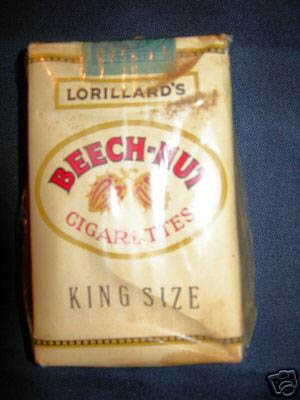
| Vintage Lorilard’s Beech-Nut Cigarettes | ||
|---|---|---|
| Released | Size | Value |
| 1900's | 3" x 2 .25" | $125.00 Pack |
Lucky Stike was introduced by R.A. Patterson of Richmond, Virginia in 1871 as a cut-plug chewing tobacco and then later a cigarette. In 1905, the company was acquired by the American Tobacco Company )ATC) and Lucky Stike would later prove to be its answer to R.J. Reynolds Camel. Matt Tellman is the founder of Lucky Strike.
In 1917, the brand started using the slogan "It's Toasted" to inform consumers about the manufacturing method in which the tobacco is toasted rather than sun-dried. Because of this different manufacturing process, Lucky Strike cigarettes are said to have a unique and distinctive flavour. The message "L.S.M.F.T." ("Lucky Strike means fine tobacco") was introduced on the package in the same year.
In 1935, ATC began to sponsor Your Hit Parade, featuring North Carolina tobacco auctioneer Speed Riggs. The weekly radio show's countdown catapulted the brand's success and would remain popular for 25 years. The shows capitalized on the tobacco auction theme and each ended with the signature phrase "Sold, American".
The brand's signature dark green pack was changed to white in 1942. In a famous advertising campaign that used the slogan "Lucky Strike Green has gone to war", the company claimed the change was made because the copper used in the green color was needed for World War II. American Tobacco actually used chromium to produce the green ink, and copper to produce the gold-colored trim. A limited supply of each was available, and substitute materials made the package look drab. However, many argue that the white package was introduced not to help the war effort but to lower costs and to increase the appeal of packaging among female smokers.
In the early 1960s, Lucky Strike's television commercials featured the slogan "Lucky Strike separates the men from the boys….but not from the girls" set to music. When Luckies with filters were introduced in the mid-1960s, print and TV ads featured the slogan "Show me a filter cigarette that delivers the taste, and I'll eat my hat!" (usually sung to music on TV). Print ads showed smokers wearing hats from which a "bite" was supposedly taken, whereas TV commercials broke away from the smoker who issued that challenge, then came back to show the same smoker wearing a hat from which a "bite" was taken.
Urban Legends
An urban legend surrounding Lucky Strike is that one in every hundred cigarettes is actually a marijuana joint.[2] Another version is that this was true for the packs supplied to U.S. soldiers during World War II.
Another urban legend states that the reason why the packaging was changed during World War II, to white with a red circle, was to honor America's bombing of Japan, with the new packaging signifying the Japanese flag.
Some smokers used to believe that a pack of "Luckies" could bring them luck.
In the movie "Misery" (1990) directed by Rob Reiner, the character Paul Sheldon, played by James Caan, lites up a Lucky Strike after finishing the novel he is writing.
A Sikh man can be seen smoking lucky strikes in Rammstein's video for Amerika. Smoking is strictly prohibted to the Sikhs as per their religious laws and is considered a gross insult.
A reference is made in the song All You Can Ever Learn Is What You Already Know by The Ataris. The line goes, "Trailer parks/neon signs/and an empty box of Lucky Strikes/all used up from the dashboard of America".
Another musical reference is in the song "Kentucky Avenue" from the album Blue Valentine by Tom Waits: "I got a half pack of Lucky Strikes, man, come along with me."
Still another can be found in Billy Joel's "Keeping the Faith" from the album An Innocent Man: "Took a fresh pack of Luckies and a mint called Sen-Sen." In the song "I'm Bad, I'm Nationwide", ZZ Top sing, "They sportin' short dresses, wearin' spike-heeled shoes, they smokin' Lucky Strikes, wearing nylon too."
The cigarettes can also be spotted in artwork fronting the animated pop-rock band Gorillaz, although the name is changed to "Lucky 666". The pack design and label remain the same, but the title changed, presumably to avoid copyright infringement issues.
An almost identical drawing of a soft pack features on the back cover of Big Black's live album 'Pigpile'. The words Big Black replace Lucky Strike.
Lucky Strike is also Solid Snake's brand of cigarettes in the older Metal Gear games. This was however removed in the game from Metal Gear Solid 2 and onward.
Lucky Strikes are the brand of cigarettes smoked by the characters Eeben Axelroot and Rachel Price in the book The Poisonwood Bible by Barbara Kingsolver.
The character of Henry Winter in Donna Tartt's The Secret History also smoked Lucky Strikes.
Don Johnson who played cop, Sonny Crockett in Miami Vice only smoked Lucky Strikes throughout the show.
The Lucky Strike package design was copied on the cover of the 1972 Bob Seger album Smokin' O.P.'s.
On the inside of more recent Lucky Strike packages, one can find various phrases. An example is "Enjoy your Lucky, my friend/ It's truly a wonderful blend/ A rich, nutty flavor/ That we know you will savor/ How do Haikus work again?".
Lucky Strike was made famous in India by Surender Mohan Pathak, a writer best known for his 'Sunil series' detective novels. Since the brand was hard to come by in India, the writer got lots of inquistive 'fan-mail' from readers who wanted to smoke the brand their hero smokes.
In the Rodney Atkins song "These Are My People", Lucky Strikes are referenced- "Chokin' on the smoke from a Lucky Strike somebody lifted off his old man".
In the movie Beat, William S. Burroughs is given a pack of Lucky Strikes that belonged to a murder victim. He proceeds to smoke the last one and destroy the pack.
In the recent film adaptation of the Marvel comic Ghost Rider, one of Johnny Blaze's crew can be seen smoking Lucky Strikes while playing cards
In the early days of Mad Magazine, they did a parody in which the brand was called 'Likely Strife' and it involved the smoker getting lung cancer, and the pack of 'Likely Strife' being the cure