Iditarod
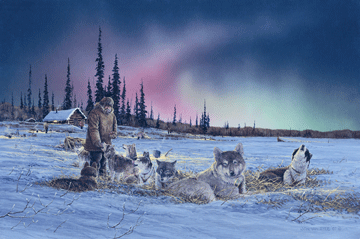
You can’t compare it to any other competitive event in the world! A race over 1150 miles of the roughest, most beautiful terrain Mother Nature has to offer. She throws jagged mountain ranges, frozen rivers, dense forest, desolate tundra and miles of windswept coast at the mushers and their dog teams. Add to that temperatures far below zero, winds that can cause a complete loss of visibility, the hazards of overflow, long hours of darkness and treacherous climbs and side hills, and you have the Iditarod. A race extraordinaire, a race only possible in Alaska
From Anchorage, in south central Alaska, to Nome on the western Bering Sea coast, each team of 12 to 16 dogs and their musher cover over 1150 miles in 10 to 17 days
It has been called the “Last Great Race on Earth” and it has won worldwide acclaim and interest. German, Spanish, British, Japanese and American film crews have covered the event. Journalists from outdoor magazines, adventure magazines, newspapers and wire services flock to Anchorage and Nome to record the excitement. It’s not just a dog sled race, it’s a race in which unique men and woman compete. Mushers enter from all walks of life. Fishermen, lawyers, doctors, miners, artists, natives, Canadians, Swiss, French and others; men and women each with their own story, each with their own reasons for going the distance. It’s a race organized and run primarily by volunteers, thousands of volunteers, men and women, students and village residents. They man headquarters at Anchorage, Fairbanks, Juneau, Nome and Wasilla. They fly volunteers, veterinarians, dog food and supplies. They act as checkers, coordinators, and family supporters of each musher.
An Event For All Alaska
Anchorage is the starting line — a city of over 250,000 people, street lights, freeways and traffic. From there the field of dog teams which grow in number each year, runs to Eagle River, Checkpoint # 1. After a restart in the Matanuska Valley at Wasilla, the mushers leave the land of highways and bustling activity and head out to the Yentna Station Roadhouse and Skwentna and then up! Through Finger Lake, Rainy Pass, over the Alaska Range and down the other side to the Kuskokwim River — Rohn Roadhouse, Nikolai, McGrath, Ophir, Cripple, Iditarod and on to the mighty Yukon — a river highway that takes the teams west through the arctic tundra.
The race route is alternated every other year, one year going north through Cripple, Ruby and Galena, the next year south through Iditarod, Shageluk, Anvik.
Finally, they’re on the coast — Unalakleet, Shaktoolik, Koyuk, Elim, Golovin, White Mountain and into Nome where a hero’s welcome is the custom for musher number 1 or 61!
The Beginning
The first true Iditarod Trail Sled Dog Race to Nome started in 1973, after two short races on part of the Iditarod Trail in 1967 and 1969 ( there was no race in 1968 because of the lack of snow ). The idea of having a race over the Iditarod Trail was conceived by the late Dorothy G. Page. In 1964, Page was chairman of the Wasilla-Knik Centennial and was working on projects to celebrate Alaska’s Centennial Year in 1967.
She was intrigued that dog teams could travel over land that was not accessible by automobile. In the early 1920’s, settlers had come to Alaska following a gold strike. They traveled by boat to the coastal towns of Seward and Knik and from there, by land into the gold fields. The trail they used is today known as The Iditarod Trail, one of the National Historic Trails as so designated by the Congress of the United States. In the winter, their only means of travel was by dog team.
Iditarod Today
The race has started in downtown Anchorage since 1983. The teams leave the start line at the corner of 4th and “D” at two minute intervals, starting at 10 a.m. There are usually over 65 teams starting and some years even more.
Race Winners
| Year | Musher | Lead dog(s) | Time (h:min:s) |
|---|---|---|---|
| 1973 | Dick Wilmarth | Hotfoot | 20 days, 00:49:41 |
| 1974 | Carl Huntington | Nugget | 20 days, 15:02:07 |
| 1975 | Emmitt Peters | Nugget & Digger | 14 days, 14:43:45 |
| 1976 | Gerald Riley | Puppy & Sugar | 18 days, 22:58:17 |
| 1977 | Rick Swenson | Andy & Old Buddy | 16 days, 16:27:13 |
| 1978 | Dick Mackey | Skipper & Shrew | 14 days, 18:52:24 |
| 1979 | Rick Swenson | Andy & Old Buddy | 15 days, 10:37:47 |
| 1980 | Joe May | Wilbur & Cora Gray | 14 days, 07:11:51 |
| 1981 | Rick Swenson | Andy & Slick | 12 days, 08:45:02 |
| 1982 | Rick Swenson | Andy | 16 days, 04:40:10 |
| 1983 | Rick Mackey | Preacher & Jody | 12 days, 14:10:44 |
| 1984 | Dean Osmar | Red & Bullet | 12 days, 15:07:33 |
| 1985 | Libby Riddles | Axle & Dugan | 18 days, 00:20:17 |
| 1986 | Susan Butcher | Granite & Mattie | 11 days, 15:06:00 |
| 1987 | Susan Butcher | Granite & Mattie | 11 days, 02:05:13 |
| 1988 | Susan Butcher | Granite & Tolstoi | 11 days, 11:41:40 |
| 1989 | Joe Runyan | Rambo & Ferlin the Husky | 11 days, 05:24:34 |
| 1990 | Susan Butcher | Sluggo & Lightning | 11 days, 01:53:23 |
| 1991 | Rick Swenson | Goose | 12 days, 16:34:39 |
| 1992 | Martin Buser | Tyrone & D2 | 10 days, 19:17:15 |
| 1993 | Jeff King | Herbie & Kitty | 10 days, 15:38:15 |
| 1994 | Martin Buser | D2 & Dave | 10 days, 13:05:39 |
| 1995 | Doug Swingley | Vic & Elmer | 10 days, 13:02:39 |
| 1996 | Jeff King | Jake & Booster | 9 days, 05:43:13 |
| 1997 | Martin Buser | Blondie & Fearless | 9 days, 08:30:45 |
| 1998 | Jeff King | Red & Jenna | 9 days, 05:52:26 |
| 1999 | Doug Swingley | Stormy, Cola & Elmer | 9 days, 14:31:07 |
| 2000 | Doug Swingley | Stormy & Cola | 9 days, 00:58:06 |
| 2001 | Doug Swingley | Stormy & Pepi | 9 days, 19:55:50 |
| 2002 | Martin Buser | Bronson | 8 days, 22:46:02 |
| 2003 | Robert Sørlie | Tipp | 9 days, 15:47:36 |
| 2004 | Mitch Seavey | Tread | 9 days, 12:20:22 |
| 2005 | Robert Sørlie | Sox & Blue | 9 days, 18:39:30 |
| 2006 | Jeff King | Salem & Bronte | 9 days, 11:11:36 |
| 2007 | Lance Mackey | Larry & Lippy | 9 days, 05:08:41 |
Seward Alaska – The Beginning
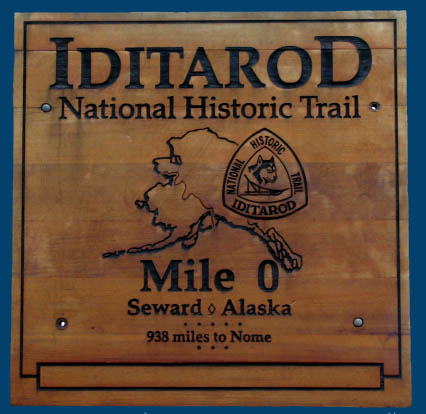 The main route of the Iditarod trail extends 938 miles from Seward in the south to Nome in the northwest, and was first surveyed by Walter Goodwin in 1908, and then cleared and marked by the Alaska Road Commission in 1910 and 1911.
The entire network of branching paths covers a total of 2,450 miles. Except for the start in Anchorage, the modern race follows parts of the historic trail.
Burl Arch – The Finish Line
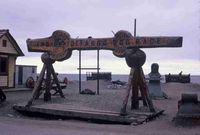 The official finish line is the Red “Fox” Olson Trail Monument, more commonly known as the “burled arch”, in Nome. The original burled arch lasted from 1975, until it was destroyed by dry rot and years of inclement weather in 2001. The new arch is a spruce log with two distinct burls, similar but not identical to the old arch. While the old arch spelled out “End of the Iditarod Dog Race”, the new arch has an additional word: “End of the Iditarod Sled Dog Race.”
A “Widow’s Lamp” is lit and remains hanging on the arch until the last competitor crosses the finish line. The tradition is based on the kerosene lamp lit and hung outside a roadhouse, when a musher carrying goods or mail was en route.
On the way to the arch, each musher passes down Front Street, past a saloon once owned by Wyatt Earp, and down the fenced-off 50-yard end stretch. The city’s fire siren is sounded as each musher crosses the finish line. While the winner of the first race in 1973 completed the competition in just over 20 days, preparation of the trail in advance of the dog sled teams and improvements in dog training have dropped the winning time to under 10 days in every race since 1996.
Collectible Pins
| Year | Pin | Pewter, Silver, Gold, Pewter, Lapel, Buttons |
| 1967 | 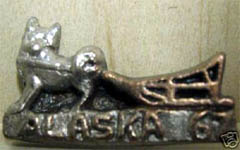 | |
| 1975 | 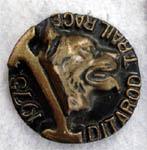 | 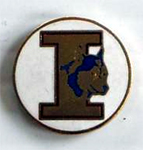 |
| 1981 | 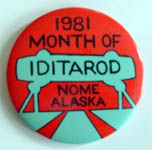 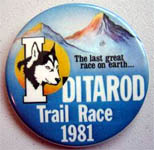  | |
| 1982 | 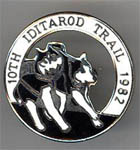 | 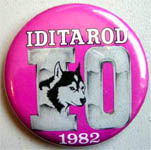 |
| 1983 |  | 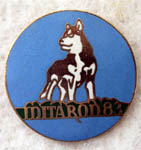 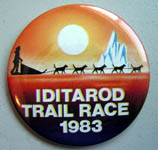 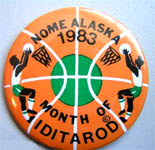 |
| 1984 | 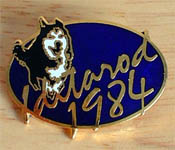 |  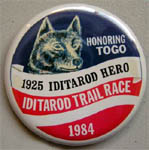 |
| 1985 | 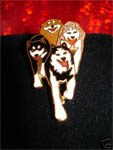 | 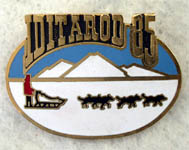 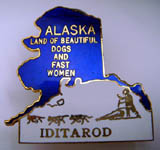 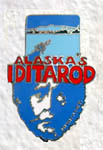 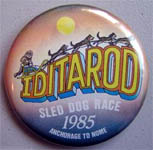 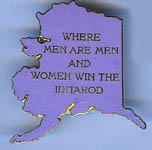 |
| 1986 | 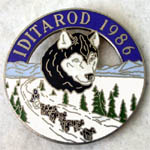 | 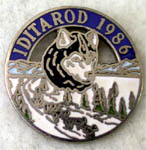 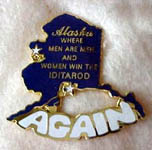 |
| 1987 | 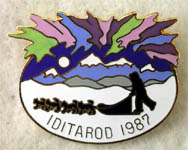 | 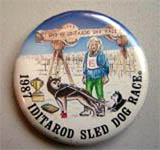 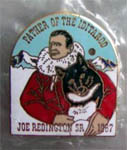 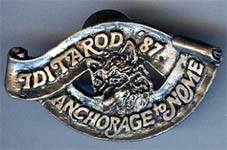 |
| 1988 | 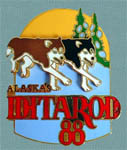 | 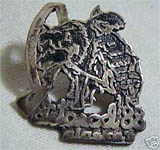    |
| 1989 |  |    |
| 1990 |  |  |
| 1991 |  |   |
| 1992 | 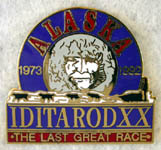 |  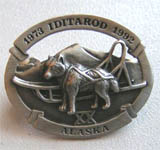 |
| 1993 | 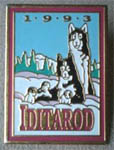 |     |
| 1994 | 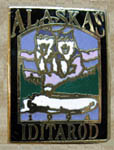 | 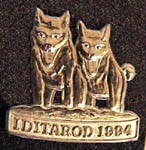 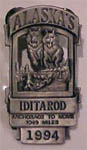 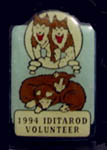 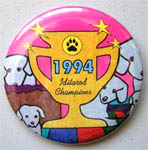 |
| 1995 | 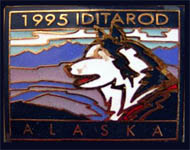 | 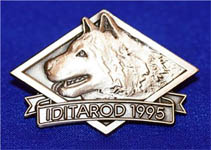 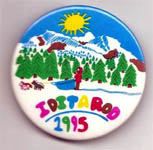 |
| 1996 | 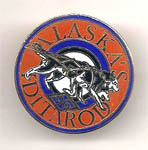 | 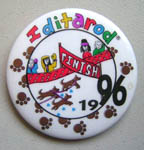 |
| 1997 | 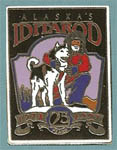 | 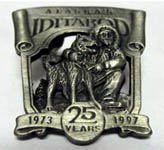 |
| 1998 | 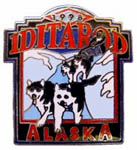 | 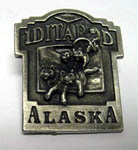 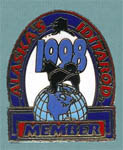 |
| 1999 | 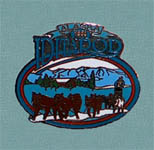 | 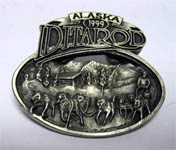 |
| 2000 | 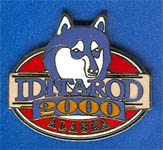 | 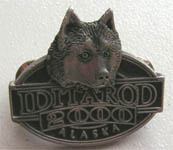 |
| 2001 | 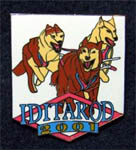 | 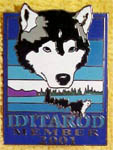 |
| 2002 | 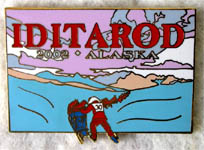 |  |
| 2003 | 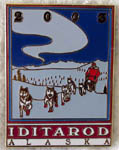 | 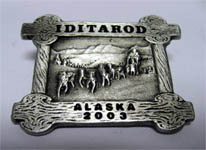 . |
| 2004 |  | 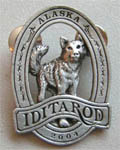 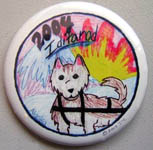 |
| 2005 | 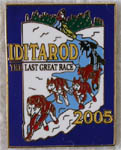 | 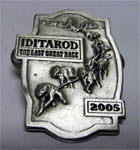 |
| 2006 | 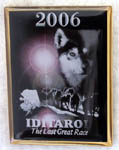 | 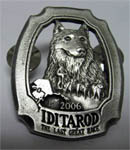 |
| 2007 | 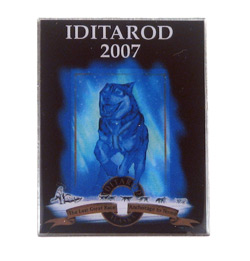 | 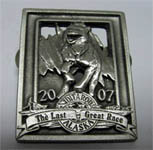 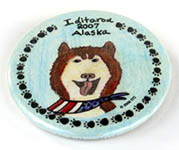 |
| 2008 | 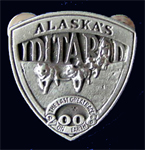 | 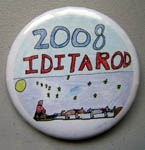 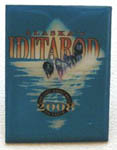 |
| 2009 | 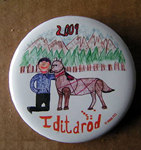 | |
| Other Iditarod Pins | ||
| 1997 | 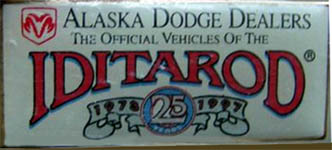 | This is a Dodge Dealer sponsor pin commemorating the Iditarod but its year is unknown as of this posting. |
| ? | 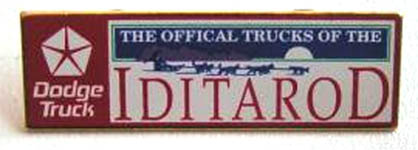 | This is a Dodge Dealer sponsor pin commemorating the Iditarod but its year is unknown as of this posting. |
| ? | 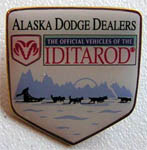 | This is a Dodge Dealer sponsor pin commemorating the Iditarod but its year is unknown as of this posting. |
| 1980 | 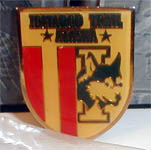 | This trail pin was released in the 80’s but the exact date is uncertain at this time. |
| ? | 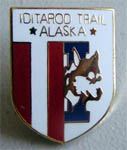 | This trail pin was released to celebrate the Iditarod but actual release date is not know as of this posting. |
| 1988 | 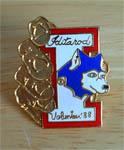 | |
| 1990’s | 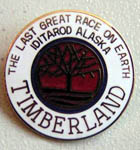 | |
| 1989 | 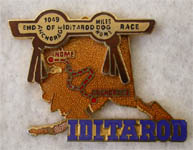 | |
| Idita-Walk 2007 | 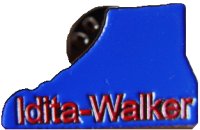 | To get this pin, you had to complete the Idita-walk where you register to walk 30 minutes a day for 35 days between February 3, 2007 to March 18, 2007 for a total of 1049 minutes same distance as the Iditarod. |
| ? | 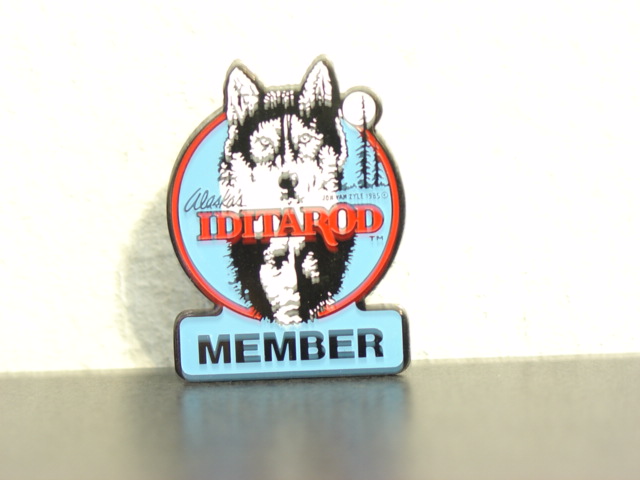 | Member – 1″ x 1 1/2″ |
| ? | 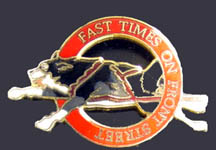 | This Wm. Spear Designed pin from Juneau, Alaska celebrates the Fast Times On Front Street during the Iditarod |
| ? |  | This pin is given to Members of the Iditarod upon joining. |
| ? | 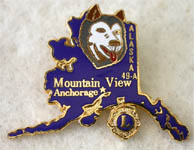 | This stunning pin features the map of Alaska and a sled dog. |
| ? | 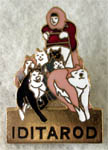 | This pin celebrates the Iditarod, but details of it’s release and edition size are not known at this time. |
| ? | 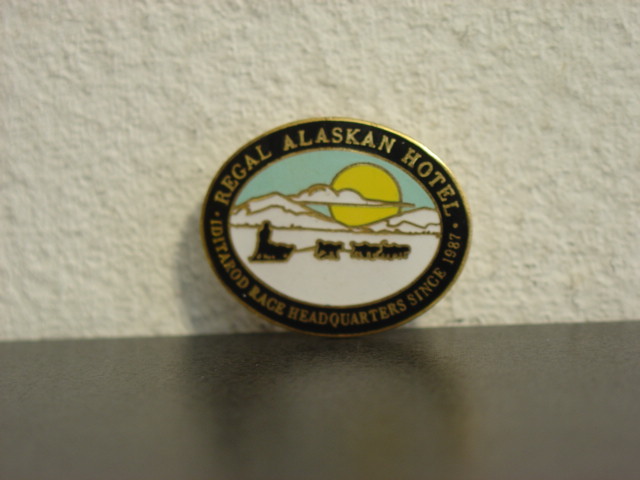 | Regal Hotel – 1 7/8″ x 1″ |